
Ross County Parole Versus Probation
Parole, post-release control, judicial release, and probation can all follow a criminal case, but they do not describe the same legal status. Ohio's Adult Parole Authority, part of the Ohio Department of Rehabilitation and Correction, supervises people released from specified state-prison terms. Parole applies to a parole-eligible prison sentence. Post-release control is a period of state supervision that follows certain prison terms. Judicial release begins with a court order that permits release from prison and places the person under court control.
Probation is often used as a plain-language term for community control imposed by a sentencing court. It can be ordered without a person completing a state-prison term. In Ross County, the public court docket is therefore the sound starting point for county community control, while the ODRC Offender Search is the sound starting point for APA supervision. The sheriff's current-custody roster cannot establish either one after release.
| Status | Who controls it | Best public check |
|---|---|---|
| Parole | Ohio Adult Parole Authority | ODRC status, POA/PRD, supervision fields |
| Post-release control | Ohio Adult Parole Authority | ODRC supervision start, period, and office |
| Probation or community control | Sentencing court | Public sentencing and termination journal entries |
| Judicial release | Sentencing court, with related ODRC status | Court order plus ODRC released status |
- Discharge
- The formal end of a custodial or supervision term.
- Absconder
- A supervised person whom the agency says has stopped reporting or cannot be located.
- POA/PRD
- The earliest parole-on-or-after or projected-release date shown in an ODRC record.
Verify Ross County Post-Release Supervision
Start with the last known custody path. A person released from Chillicothe Correctional Institution or Ross Correctional Institution belongs in the statewide ODRC system, not the Ross County Jail roster. A person placed on community control by Chillicothe Municipal Court or Ross County Common Pleas remains tied to the sentencing case. Identity matters in both routes. Match the full name with date of birth, offender number, case number, and committing county before relying on a status.
- Open the ODRC Offender Search for a known state-prison or APA case. Search by offender number when available, or begin with a broad name search.
- Select the matching record after checking date of birth, docket, offense, and committing county. Do not confuse committing county with residential county.
-
Read the exact status.
APA SUPERVISIONsupports current state supervision. A future expected date or a parole hearing result alone does not prove release. - Review Supervision Start Date, Period of Supervision, Residential County, ZIP, and APA Offices. These fields show when supervision began and which office label applies.
- For county community control, search the correct court docket for the sentence, later modifications, termination, or discharge. Obtain the journal entry when firm verification is needed.
The Ross County released-inmate search path explains how a jail release record and court order fit together when the custody history is uncertain. A court order may establish authority, while an ODRC status documents a different state-prison track.
For context, the official ODRC search form shows the status and county filters used in this process.
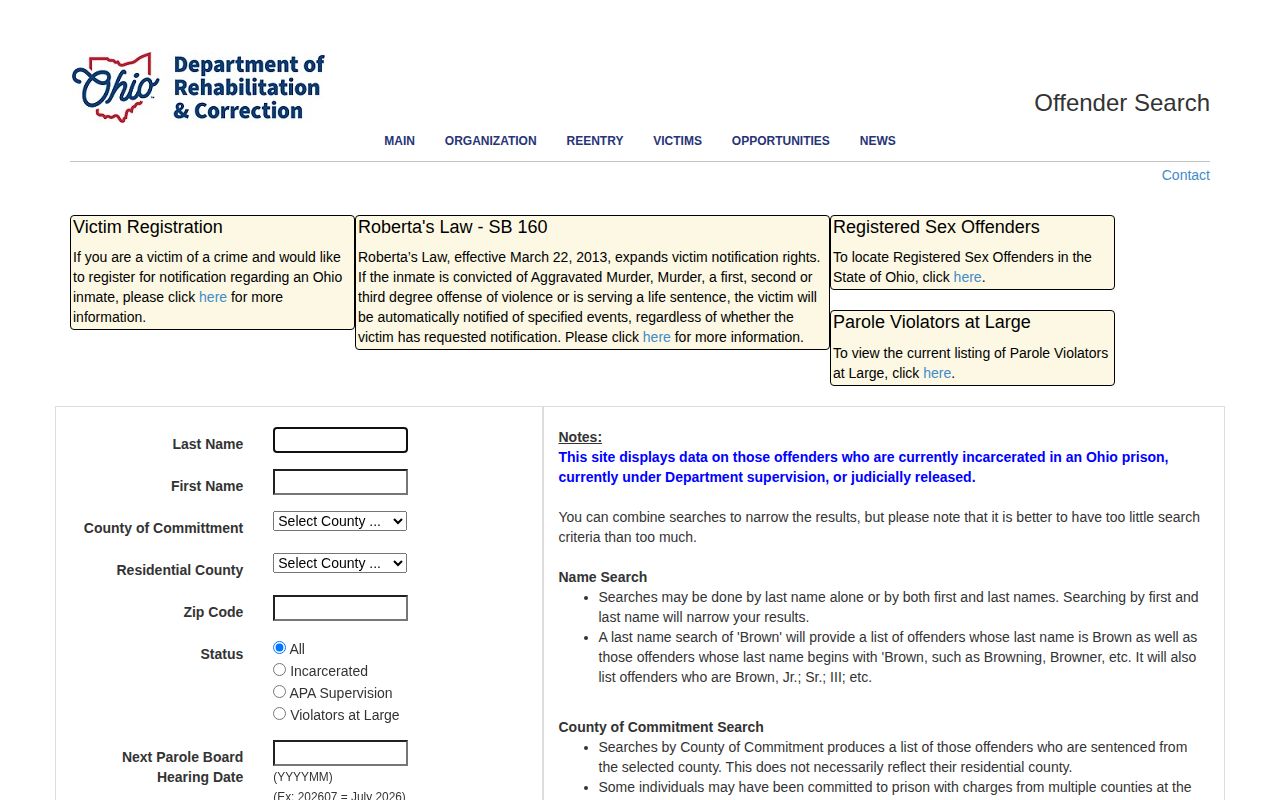
The form separates APA supervision from incarceration and released results, which is why a focused status search is more useful than a general name query.
Ross County APA Office Fields
An official Ross-residential ODRC example shows office label
CHILLICOTHE 1 with APA SUPERVISION, a
supervision start date, and a supervision period. That example
proves which fields can appear. It does not establish the
status, dates, conditions, or office assignment of anyone else.
The office label must be read from the matched person's own ODRC
detail.
Research did not verify a working ODRC directory page with a current street address for that office. A street address should not be guessed. Use the office label on the individual record and ask ODRC to confirm the correct contact point. When the issue concerns court community control, contact the court or clerk tied to the sentence instead of the APA office.
Public lookup: ODRC Offender Search
Records fallback: ODRC Central Records, P.O. Box 430, Columbus, OH 43216
Local label verified in an official example: CHILLICOTHE 1
Note: Confirm the local office from the matched record because assignments can change and the public directory link was unavailable during research.
Ross County Parole Violator Checks
ODRC maintains a separate Parole Violators at Large listing. Its public fields include a photo, name, offender number, date of birth, declared-violator-at-large date, and offenses. A listing means the Adult Parole Authority says a person released to supervision has absconded. It does not prove the person is back in prison. It also does not authorize a member of the public to approach or detain anyone.
Compare the listing with the person's ODRC detail, especially the exact status and declared date. If a later arrest is suspected, check the current holding agency rather than assuming a return to CCI or RCI. Ohio law authorizes retaking in ORC 2967.15, but only law enforcement can verify an active warrant through its systems. ODRC directs tips to the Fugitive Section at 614-752-1114 or Fugitive.Val@odrc.state.oh.us and warns against apprehension. Call 911 for an emergency.
Ordinary violations do not all produce the same public result. Conditions and sanction proceedings may include information excluded from Ohio's public-record definition. The public ODRC status and court journal entries are safer sources than a request for an entire supervision file.
Ross County Parole Hearing Results
The Ohio Parole Board's practical public schedule is built into
ODRC Offender Search. Enter a Next Parole Board Hearing Date in
YYYYMM format to find people currently scheduled
for that month. This is a rolling monthly query, not a
day-by-day calendar. ODRC also explains that a future displayed
hearing date usually means review occurs about two months
earlier so a decision can be made before that date.
Open the individual detail and reproduce the exact Next Parole
Board Hearing/Review Month and Latest Parole Board
Hearing/Review Type & Results fields. Results can use
phrases such as continued hearing, continued hearing/parole,
central office board review/paroled, or transitional-control
review denied. Do not force them into a simpler
granted-or-denied label. Even PAROLED must be
checked against POA/PRD and later status because a favorable
result is not the same as completed physical release.
ORC 2967.13 governs parole eligibility for covered terms. Eligibility allows consideration; it does not guarantee release. Ohio VINE can provide listed ODRC events such as parole-hearing notice, revocation or return, and release from parole when a person is registered. The state warns that VINE should not be the only source, so confirm the event in ODRC or with the responsible agency.
Note: No separate official decisions database or stand-alone Ohio parole calendar was verified, so use the monthly search and individual detail.
Ross County Supervision Discharge Records
Supervision ends through a formal discharge, termination, or other agency or court action. For APA supervision, start with the person's ODRC detail and look for the status, period, and any end or release detail the public record supplies. If the term is fully discharged and the person no longer falls within ODRC's displayed groups, write Central Records with the offender number, date of birth, committing county, docket, and the exact discharge fields requested.
For Ross County community control, request the public journal entry that terminated or discharged supervision. The Common Pleas docket is used for indicted felony cases. Chillicothe Municipal Court has a separate portal for misdemeanors, traffic matters, and preliminary felony stages. Public entries can verify a court action even though ORC 149.43 excludes broad categories of probation, parole, community-control, post-release-control sanction, and release-determination proceeding records.
A missing online record is not proof of discharge. It can result from the scope of the portal, indexing, age, sealing, or expungement. Ask for the specific public entry or retained discharge record rather than asking an office to create a new account of the case.
Ross County Reentry Contacts
Ross County has local navigation points outside the statewide APA search. The sheriff's divisions page identifies Ross County Community Corrections, while the official contact page lists a Re-Entry Center at 740-702-1200. These contacts can help a released person or family reach the right local office. They do not establish that a named person is enrolled, eligible, on probation, or under a given set of conditions.
Use the records in the correct order. A matched court journal entry establishes county community control. An ODRC record showing APA supervision establishes the state track. Local program contacts can then help route practical questions. That separation matters in Ross County because the county jail and two state prisons sit in the same county but report release and supervision through different systems.
Property After Ross County Release
Post-release needs can begin before a supervision appointment. The Ross County Jail handbook states that inventoried personal property and clothing are returned at release with a signature. A commissary balance is issued on a preloaded card. Those steps concern a county-jail exit and should not be mistaken for APA conditions or proof of a state-prison discharge.
A transfer to prison follows a different property rule. The handbook says a named person should collect property before transport, and unclaimed items are held no more than 48 hours before destruction. In that setting, Ross County custody has ended, but the person remains confined under ODRC. Verify the new state status before treating the roster disappearance as community release.
Note: Property return documents a jail process, while the release sheet and court or ODRC record establish the legal custody outcome.