
Ross County Projected Versus Actual
A projected date is a calculation based on the sentence and the information known at the time. It can mark a likely sentence end, an earliest release point, or the month when a person becomes eligible for parole consideration. An actual release date is retrospective. It records that the responsible agency completed a release or transfer. Confusing the two can turn a planning date into a false report that custody has ended.
ODRC combines two ideas in one public label: Expected Release Date/Parole Eligibility Date. Its definitions describe the field as a projected release date or a date pending parole consideration. For a definite prison term, the field may act like an estimated end date. For an indeterminate or life term, it can mean only that consideration becomes possible. A hearing or eligibility date does not command release.
Pretrial status is different. Someone held at Ross County Jail while a case is pending does not have a sentence-based release date. Bond may be set but not posted, or another warrant or detainer may block release. The jail and court must be asked about the current basis for custody.
Find a Ross County Projected Date
Identify the custody class before opening a search. CCI and RCI are state prisons, even though both are in Ross County. Ross County Jail is a sheriff-operated county facility. The statewide offender page does not compute an ordinary county-jail sentence unless the case became an ODRC commitment.
- For a state prisoner, open the ODRC Offender Search. Use the offender number when known or search by name with care.
- Match date of birth, docket, committing county, offense, and last institution. Do not use Residential County as though it were the sentencing county.
- Read Expected Release Date/Parole Eligibility Date, POA/PRD, sentence fields, jail-time credit, and the exact current status together.
- For Ross County Jail, check the sentencing journal entry and ask the jail for its computed date. Ask whether another hold affects release.
- For a pretrial detainee, read bond and court orders instead of expecting a sentence-release field.
- Confirm the event after the date arrives. A release sheet, changed ODRC status, or supervision start is stronger than the old forecast.
The Ross County release-record process explains how to request an exact county release date and disposition. It is the better route once the projected date has passed or a name has left the current-only jail roster.
The ODRC field definitions display the language that governs the statewide date labels.
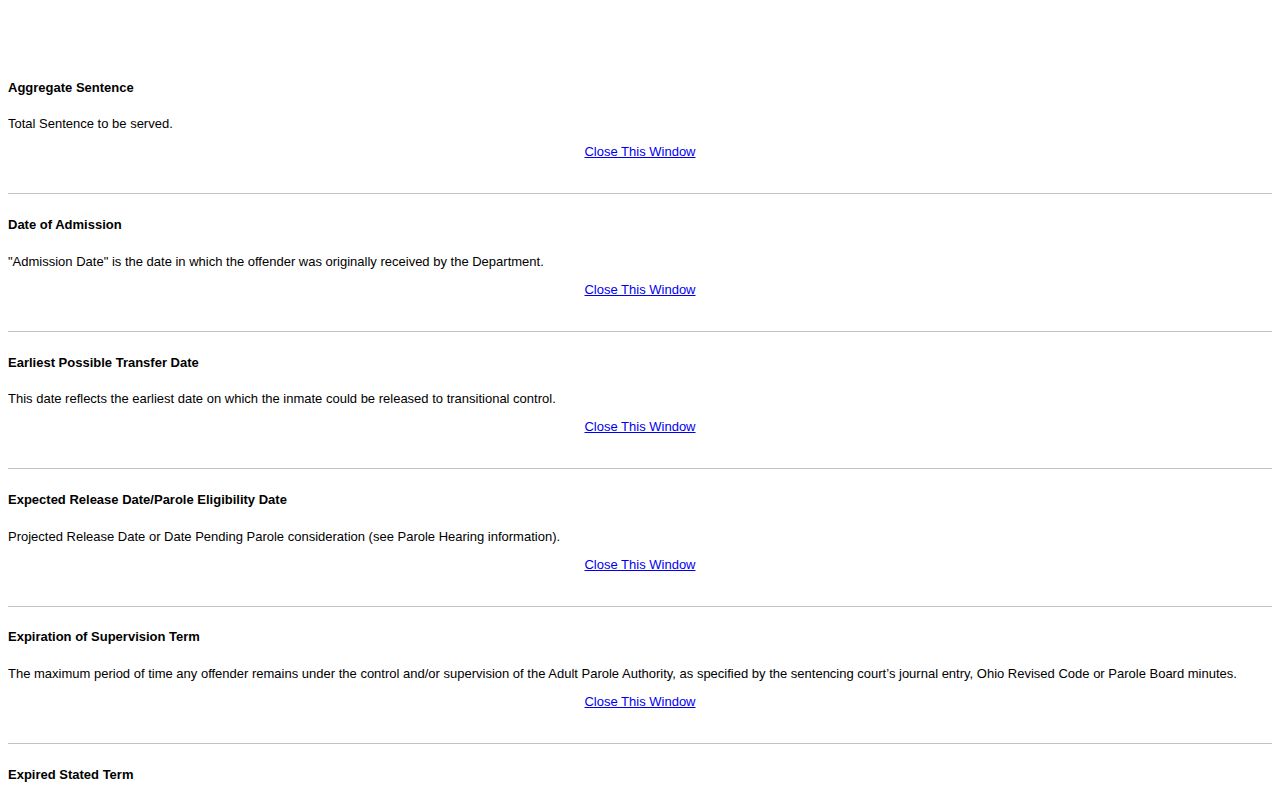
Those definitions keep the expected, parole, transfer, and supervision dates separate, which prevents a planning field from being reported as a completed release.
Ohio Credit Changes Ross Release Dates
Ohio has no universal rule that each prisoner serves exactly 85 percent of every term. Current ORC 2967.194 permits eligible people provisionally to earn one or five days per month through productive participation, along with qualifying completion credit. The ordinary participation and completion aggregate described by the statute is capped at 15 percent of the stated term. That cap creates an 85-percent shorthand for some eligible terms, not a rule that applies to every person or sentence.
Eligibility depends on the sentence and conduct. Mandatory portions, murder categories, life without parole, specified sex or violent offenses, program completion, administrative review, and other exclusions can change or defeat the shortcut. Credits may be denied or withdrawn for rule violations. The correct calculation must be based on the person's own sentence record and the law that applies to it.
The ODRC historical credit chart separates regimes by offense date. Older HB 261 cases had former good-time and earned-credit rules. Senate Bill 2 eliminated good time for the modern definite-term regime while retaining specified earned credit. Later laws expanded or changed participation and completion credit. Confinement date and offense date therefore matter.
Jail-time credit is another field. It credits qualifying time already spent in custody toward the sentence. It appears by offense or sentence in ODRC detail, but it is not the same as later earned participation credit.
Why Ross Release Dates Move
A date can move because the legal sentence, available credit, agency decision, or destination changed. Some changes move a forecast. Others keep the forecast intact while preventing community release. Read the source record for each cause rather than inferring a new date from roster removal.
| Factor | Effect on the date or outcome | Where to verify |
|---|---|---|
| Earned credit | May reduce an eligible term after required participation or completion. | ODRC detail, ORC 2967.194, Central Records |
| Credit denial or withdrawal | Can move an expected date later after conduct or administrative review. | ODRC record and applicable decision |
| Jail-time credit correction | Changes the amount of prior custody applied to the sentence. | Sentencing entry and ODRC sentence detail |
| Parole result | Eligibility may lead to denial, continuation, or a later POA date rather than immediate release. | ODRC hearing fields and POA/PRD |
| Court order | Judicial release, resentencing, or another order can alter the custody path. | Sentencing-court journal entry |
| Detainer or hold | May transfer custody to another agency instead of allowing community release. | Jail release record and receiving agency |
| Reagan Tokes proceeding | Can continue qualifying non-life indefinite confinement beyond the presumptive point, up to the maximum. | ODRC record and ORC 2967.271 |
Under ORC 2967.271, qualifying non-life indefinite first- and second-degree felony sentences have a presumptive release framework at the diminished minimum or presumptive earned early release date. ODRC can hold a rebuttal proceeding and continue incarceration within the statutory maximum. That structure is another reason one expected date cannot be treated as a guarantee.
Confirm Ross County Release Dates
For a state prisoner, confirmation rests on present-tense ODRC
status and operative or retrospective fields.
APA SUPERVISION plus a supervision start date
supports release under state supervision.
RELEASED - Judicial Release points to a
court-authorized outcome that should also be checked in the
sentencing docket. INCARCERATED means prison
custody continues even if a past hearing result contains
favorable language.
POA/PRD is the earliest release on APA supervision. POA means parole on or after, while PRD means projected release date. Earliest Possible Transfer Date concerns transitional control, not community release. TC/TT Sentence Expiration concerns exit from a transitional-control or treatment-transfer placement. Supervision Start Date can help confirm that prison release has occurred.
For Ross County Jail, request the existing release sheet or jail card for the exact date, time, and disposition if maintained. Pair it with the court order that explains bond, sentence, dismissal, or another legal basis. A transfer destination may show that county custody ended while confinement continued elsewhere.
A pending event can also be followed through the Ross County VINELink check. Register while the person is in custody, preserve the alert, and then corroborate it with the reporting agency.
A released filter must still be read with care. ODRC can return exact labels such as judicial release, APA supervision, or released-death status. The last of those must never be framed as community release. ODRC also warns that its offense list may not be complete and that a displayed supervision period can relate to a prior offense. Match the docket and sentence instead of treating one field as a full case history.
If the projected and actual records conflict, compare their timestamps and purposes. A computed date may predate a credit change, Board action, court order, or hold. Ask Central Records to confirm or correct the identified field, giving the offender number, date of birth, committing county, and docket. For a county record, give the sheriff the booking number and date range so staff can locate the correct episode.
Ross County Jail Date Channel
No Ross-specific county good-time formula or weekend-release rule was verified in the research. None should be supplied by analogy to another Ohio county or by applying ODRC fields to a local sentence. The sentencing journal entry, jail-time credit, the jail's own computation, other holds, and the eventual release sheet control the county-jail answer.
Call Ross County Jail at 740-773-1187 and ask for the computed date for the named sentence, using a booking number and case number when known. For a written record, request the existing booking or release record from the Ross County Sheriff's Office. Ask for the date and time, release disposition, releasing authority, and transfer destination if those fields are maintained. Ohio public-records law does not require the office to create a new calculation or narrative.
A pretrial detainee belongs on a different path. Check the correct court for bond and later orders, then ask whether another hold prevents release. A bond setting is authority for possible release, but it does not prove that bond was posted or jail processing was complete.
Note: A current-only roster can show continued listing, but disappearance alone cannot identify release, transfer, timing, or the controlling order.
Ross Parole Dates Are Not Gates
ODRC Offender Search accepts a Next Parole Board Hearing Date in
YYYYMM format. The result is a rolling monthly
query, not a public day-by-day release calendar. Individual
records can show a Next Parole Board Hearing/Review Month and a
Latest Parole Board Hearing/Review Type & Results field.
Exact result strings vary and should be copied as displayed.
Eligibility under
ORC 2967.13
opens the possibility of Board consideration. It is not a gate
date. A continued or denied result can explain why an earlier
eligibility date did not become release. Even a result
containing PAROLED must be paired with POA/PRD and
later status because conditions and a future operative date can
remain.
When public fields conflict or appear stale, write ODRC Central Records at P.O. Box 430, Columbus, OH 43216. Include the offender number, date of birth, committing county, docket, and the exact field needing confirmation or correction.